
The question turns up in my inbox almost every week, usually with a small apology attached to it. People write something like “sorry if this is a stupid question, but how much money do I actually need to start?” It is not a stupid question. It is the most practical one in the whole business, and the industry has spent about two decades answering it as vaguely as it can get away with.
I have been writing about markets and trading platforms for years now, long enough to have watched a fair number of beginners open an account, empty it, and quietly stop replying to messages. The pattern repeats with almost no variation. Very few of them failed because they started too small. They failed because the amount, the risk per trade and their actual skill level were badly matched at the moment they clicked buy.
So let me answer this the way I would answer it for a friend over coffee. Numbers where numbers help, and a straight “it depends, and here is what it depends on” everywhere else. I am not a financial adviser, and none of this is advice to put money into any market. Think of it as a walkthrough of how the minimum is really calculated.
The first thing you spend is not money
This sounds like a platitude right up until you do the arithmetic. The scarce resource for a beginner is not capital, it is hours spent watching price move while following a written set of rules. Leverage you can borrow, and funds you can always add later.
The two or three hundred hours it takes before a chart stops looking like noise, those you cannot buy from anybody.
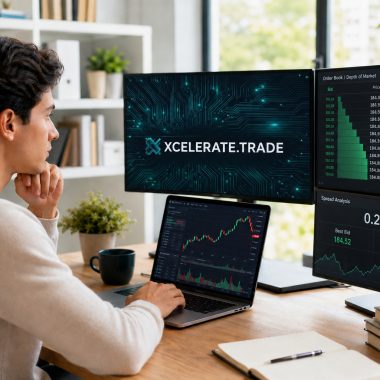
The way Xcelerate Trade is put together leans on that idea fairly hard. Academy first, practice environment second, execution somewhere further down the line, which is more or less the reverse of how most people arrive at the markets. The usual sequence is deposit on Tuesday, first live trade on Wednesday, first panic on Thursday. That order of operations is the most expensive habit in retail trading, and it costs far more than any spread ever will.
Accept the slower sequence and the money question changes shape completely. What you actually need to know is how much capital you need at the moment you start taking real market risk, and that moment might be three or four months after you sign up. The gap is not lost time. It is the cheapest tuition available anywhere, and it is the only tuition that gets refunded in full if you decide trading is not for you.
Why the learning phase costs nothing in market risk
Replay and demo are what make the first stretch free in terms of exposure. Replay hands you a historical session and lets you walk through it bar by bar, so you practise reading structure without knowing what comes next. Demo puts you in live conditions with simulated money, which tests a different muscle entirely, mostly what you do when the number on the screen starts moving the wrong way.
I always tell people to stay in replay longer than feels reasonable. One evening of replay can hand you fifty decisions. One live session might hand you two, and one of those will be a decision you took out of boredom. That compression is how the pattern library gets built, the one that later feels like instinct but is really just repetition with a nicer name.
There is a catch, obviously. Demo accounts will lie to you if you let them. Nearly every platform drops a simulated fifty or a hundred thousand into your balance, and something odd happens to people when the money is fake and the number is huge. They take positions ten or twenty times bigger than anything they would ever risk in real life, and then the move to a live account feels like switching sports halfway through the season.
How to make demo tell the truth
Set the demo balance to whatever you honestly plan to deposit later. If that figure is eight hundred euros, trade eight hundred in demo. You are rehearsing, and rehearsing with a hundred thousand tells you nothing about how it feels to be down forty euros before lunch on a slow Tuesday.
Use the same position sizing you intend to use with your own money, down to the decimal. If your rule says one percent, risk one percent. In my experience the people who cross over to live trading without drama are the ones whose demo statements look small and slightly boring.
One more thing, and people resist this one for months. Keep the journal while you are still in demo, not later when the trading gets serious. A trade you did not write down turns into a trade you remember incorrectly, usually within about four days, and always in your own favour.
The math that sets your real minimum
Most articles get vague here and quote whatever minimum deposit the broker prints on its homepage. That figure tells you what the broker will accept, not what you need. The real minimum comes from two things, the smallest position you are able to open in your chosen instrument and the amount you are willing to lose if that position goes wrong.
So work backwards instead. Decide your maximum loss per trade first, and one percent of the account is where most experienced traders end up after they have been burned once or twice. Find the smallest position size available on the instrument you want.
Then check whether that position, with a stop placed where the chart actually needs it, still fits inside your one percent. If it does not fit, the account is too small for that instrument, and being confident about the trade changes nothing.
What this does is quietly useful. It turns a vague worry into a calculation you can run in ninety seconds, per instrument, before you have deposited a single euro.
A worked example on a currency pair
Take EUR/USD, which is where almost everyone starts, mostly because the spread is tight and there is always somebody on the other side. On a micro lot, meaning a thousand units of the base currency, a pip is worth roughly ten cents. If your setup needs a twenty pip stop, and twenty pips is fairly ordinary for an intraday entry, you are risking about two dollars on the smallest position the broker will let you open.
Now run the one percent rule backwards. If two dollars has to represent one percent of the account, the account needs to sit somewhere around two hundred dollars. Go below that and you are either risking more than your rule allows or you cannot open the trade at all.
Some brokers offer nano lots, which push the pip value down to a cent and let you technically trade a fifty dollar balance. I have never seen anybody learn much that way. The outcomes are so small that nothing emotional gets triggered, and the emotional part is half the training. The money has to matter a little, otherwise your discipline never actually gets tested.
The same math on an index and a share
Indices work differently because one point can carry real weight. On a CFD tracking the Nasdaq 100, the smallest size is usually a hundredth of a lot, and even then a fifty point stop can put twenty or thirty euros at risk. Apply the same one percent logic and you end up needing something in the region of two or three thousand euros before that instrument stops being a coin flip with your rent money.
This is exactly where beginners get caught. They deposit three hundred euros, pick the index everyone on social media talks about because it moves so beautifully, and lose a third of the balance across two sessions. Nothing was wrong with the instrument. The pairing between the instrument and the account was wrong, and nobody warned them there was a pairing to think about.
Individual shares land somewhere in the middle, particularly now that fractional shares are common. Say you buy a fifty euro share with a stop two percent below entry. That is one euro of risk per share, so ten shares put ten euros at stake, which fits comfortably inside a thousand euro account. If you are planning to open and close in the same session through a US broker, there is a separate wrinkle, because the pattern day trader rule sits at twenty five thousand dollars, and that single threshold is why a lot of European beginners end up on CFDs or futures instead.
Costs that quietly eat a small account
Spread gets all the attention and is honestly the smallest of your problems. On a small account the dangerous costs are the fixed ones, the ones that stay the same size while your position shrinks. Two euros of commission per side barely registers on a five thousand euro account. On three hundred euros it is a wound.
Then there is overnight financing, the swap, which lands on any leveraged position you hold past the daily rollover. Hold something for a week and the financing can end up bigger than the move you were waiting for, which is a genuinely deflating way to be right about a trade. Currency conversion is another cost people forget entirely, especially anyone funding a dollar account from a euro or leu bank account.
Slippage deserves its own paragraph because beginners assume it only shows up around news releases. It shows up whenever liquidity gets thin, which for European traders often means the first frantic minutes after the US open, or the empty stretch in the middle of the afternoon. A stop that fills three points worse than planned turns a one percent loss into something closer to one point four, and repeated forty times over a year that difference is the whole result.
Add these up honestly before you deposit anything. If the round trip cost of a trade is one and a half euros and your average risk is three euros, then half your risk budget belongs to the house before you have even been right or wrong. That ratio has to improve for the account to have any chance, and the two ways to improve it are a bigger balance or a longer holding period.
Drawdown math decides how long you last
There is one piece of arithmetic every trader should stick to the side of the monitor. Lose twenty percent and you need twenty five percent to get back to even. Lose thirty and you need forty three. Lose half and you need a full hundred percent, meaning you have to double what is left just to return to the starting line.
That asymmetry is why professional risk limits look absurdly timid from the outside. Risking one percent per trade seems pointless until you realise that eight losses in a row, which happens to absolutely everyone sooner or later, costs you eight percent and leaves you perfectly functional. The same streak at five percent per trade takes a third of your account and, worse, takes your composure with it.
I have watched this play out with people I know personally. The ones still trading after their first year were not the sharpest chart readers in the group. They were the ones whose worst month was minus six percent rather than minus forty, which is the boring reason they were still around in month eleven when things finally started to make sense.
So when you calculate a starting figure, build in a survival buffer. Whatever the position sizing math gives you, adding another thirty or forty percent on top buys room to be wrong repeatedly without being finished. Xcelerate.Trade puts most of its early emphasis on this order of thinking, risk first and entry second, and I would argue that habit is the single most valuable thing a beginner picks up in the first months.
Where the token side fits into the budget
There is a second kind of money question that comes up around Xcelerate Trade specifically, because the ecosystem has its own token and a tiered access structure built on top of it. People blur the two budgets together and end up genuinely confused about what they need before they can start. They are separate things and belong in separate mental pockets.
Trading capital goes to your broker and gets exposed to the market. Access capital, if you choose to hold any, relates to what you can reach inside the platform, the marketplace, the pools and the governance side. One does not substitute for the other, and holding a token has never made an oversized position any safer.
I am deliberately not quoting tier thresholds, because those figures change and a stale number in an article is worse than no number at all. Read the current tiers on the platform before you budget anything on that side. What I will say is that a beginner takes almost all of the available value from the learning material and the practice environment, and that part does not ask for a large commitment.
Copy trading as a study tool rather than a shortcut
Every time a platform launches a copying feature, the same daydream comes back around. You attach your account to somebody clever and go back to your life. It works for a while, then the trader you followed hits their own rough patch, and because you never understood the reasoning behind the positions, you unplug at the worst possible moment. I have watched that exact sequence enough times to be blunt about it.
Used differently, it earns its place. Follow a strategy through Copy Trading, treat every mirrored position as a case study rather than a payday, and you get something replay cannot give you, a live decision unfolding in real time, taken by somebody with more mileage than you. Write down why you think the position was opened before you know how it ends. Then check your reasoning against the result.
The capital side matters here too. Copying still needs enough balance for the proportional sizes to make sense, and a very small account often ends up copying at a size where costs swallow the outcome. If you go down this road, apply the one percent thinking to the total allocation, not only to individual trades.
My honest opinion is that copying supplements learning and replaces it very badly. Someone who copies for a year without writing anything down finishes exactly where they started, minus fees. Someone who copies for three months while taking notes finishes with a much clearer picture of how a real strategy behaves during a bad week, which is knowledge you cannot get from a course.
Three realistic starting brackets
Here are actual numbers, with the caveat that they describe situations rather than instructions. Somebody starting with two or three hundred euros is in the learning bracket. That account exists to make the jump from demo to live feel real, it belongs on forex micro lots or fractional shares, and everyone involved should understand that meaningful income is not on the table and that losing the lot should not touch anyone’s rent.
The middle bracket, roughly one to three thousand, is where the math starts to breathe. Costs shrink as a share of each trade, more instruments fit inside a sane risk budget, and a losing streak stops forcing decisions you would not otherwise make. Most people I know who eventually got somewhere spent a year or longer in this range, topping the account up monthly from salary instead of waiting for it to grow on its own.
Past five thousand you have real flexibility, though flexibility cuts both ways for somebody who has not built the habits yet. Personally I would rather see a beginner start at eight hundred with strict rules than at ten thousand with none. A bigger account only helps once the discipline is already there, and the fact that Xcelerate.Trade puts the learning path in front of the execution tools reads to me like a quiet admission of the same thing.
What I would personally do with five hundred euros
If somebody handed me five hundred euros and told me to start today, I would not deposit it. I would spend two months in the Academy and in replay, then a month in demo sized to exactly five hundred, and only then move the money across. That is slow, I know. Slow is also the only version I have seen work for the people I have followed over the years.
Once it was live, I would trade one instrument, take no more than two setups a day, and risk five euros a trade. Five euros sounds almost insulting when you say it out loud in front of somebody. It also means you would need a hundred losses in a row to empty the account, and that arithmetic hands you the one thing beginners never give themselves, which is time.
I would also decide in advance what would make me stop. For me, a monthly loss of fifteen percent means back to replay for a fortnight, no negotiating with myself. Setting that rule while calm takes thirty seconds. Setting it while you are down is impossible, which is precisely why it has to be written before.
The paperwork nobody mentions
Whatever you deposit, there is an administrative layer sitting underneath the returns that almost nobody writes about. Trading profits are taxable in most places, the treatment usually differs depending on whether your broker is domestic or foreign, and the reporting burden tends to land on you rather than on the platform. In Romania, where I write from, it matters a great deal whether the intermediary is local or not, since that determines who declares what, and the rules have been rewritten more than once in recent years.
I am not going to quote rates. Tax rules move, and a stale percentage is worse than an honest gap. Talk to an accountant before your first profitable year rather than in the middle of your first filing deadline, and keep clean statements from day one. Reconstructing twelve months of trades in April is its own particular kind of misery, and I say that as somebody who has watched a friend do it with a spreadsheet and a bottle of wine.
There is also the quieter question of what the money means to you. An account funded from savings you might need in six months creates a pressure that shows up in your trading long before it shows up in your bank statement. Capital you can genuinely afford to lose is not a legal disclaimer at the bottom of a page. It is a performance requirement.
The number that matters more than your balance
If you force me to reduce all of this to a single figure, it is not the deposit. It is how many months your account survives while you are still bad at this, and that number depends on position size rather than on starting capital. Two hundred euros risked at two euros a trade lasts longer than ten thousand risked at four hundred.
That reframing is really the whole answer. Ask how much time your money buys instead of how much money you have, and the amount you need turns into something you calculate rather than something you guess at. Start from the risk per trade, work outward to the account size, then add a buffer for the losing streak that has not arrived yet.
And be patient with the dull part. Every trader I know who is still doing this after five years describes the same first year, quiet and small and mildly tedious, full of notes nobody else would ever want to read. That year is the real entry fee, and it gets paid in attention rather than in euros.
Frequently asked questions
Can I really start with a hundred euros
Technically yes, through a broker offering nano lots or fractional shares. In practice a hundred euro account teaches you order entry and almost nothing about risk, because the sums involved are too small to provoke any reaction from you. Treat it as a bridge between demo and a properly sized account rather than a serious attempt at trading.
Does more capital mean faster progress
No, and the relationship may well run the other way. Bigger accounts allow bigger positions, bigger positions produce bigger swings, and bigger swings tend to break the discipline of anyone who has not built it yet. Progress comes from repetition inside a rule set, and repetition is available at any size.
How long before I stop losing money
Longer than the advertising suggests. Studies of retail day traders, including the widely cited Brazilian dataset and the older work of Barber and Odean, keep finding that only a small minority reach sustained profitability, and those who do generally need a year or more. Size your capital so it survives twelve months of learning rather than three months of optimism.
Should I use leverage on a small account
Leverage is what makes a small account viable at all, since without it you could not open a position of any useful size. The danger is not leverage as such, it is using all the leverage available rather than the amount your stop actually requires. European rules cap retail leverage on major currency pairs at thirty to one, and most sensible traders operate at a fraction of that, sizing from the stop instead of from the broker’s maximum.
Is it better to add money monthly or deposit everything at once
Adding monthly has two advantages that have nothing to do with markets. Your position sizes grow gradually alongside your competence, and one bad month cannot erase a lump sum you spent two years saving. The drawback is psychological, since a steadily rising balance can trick you into treating fresh deposits as profits.
What happens if I lose my whole starting account
If it was money you could afford to lose, you paid for tuition and collected data, assuming you kept a journal. If it was not, you have a bigger problem than trading and should deal with that first. The people who recover from a blown account are the ones who go back to replay and demo instead of immediately funding a second one, because funding a second one straight away is how a single bad account turns into three.
Do I need capital to use the learning tools
The Academy content and the practice environment sit at the front of the Xcelerate Trade experience, and that stage costs time rather than deposits. Plan your budget so the money arrives at the same moment the skill does, not before it. Anyone telling you the order works the other way around is selling something.
How do I know I am ready to trade live
The honest signal is a sample of trades, not a feeling. Roughly a hundred journaled entries in replay and demo, taken under one written plan, with a column recording whether you followed the plan on each one, will tell you far more than any amount of confidence. If your plan compliance is under eighty percent, more capital will not fix what is broken.