
I would rather understand why a trade belongs in a plan than hear another confident prediction about Bitcoin. A prediction can sound sensible and still leave me guessing about when to enter, how much to risk, and what would prove the idea wrong. When money is involved, those missing details matter more than the confidence of the person speaking.
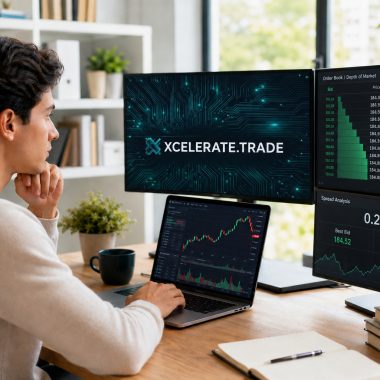
That is how I approach Xcelerate Trade: as an educational framework for making trading decisions specific enough to examine. Its public material connects lessons, strategy playbooks, and chart indicators, with risk management and practice running through the process. My reading of that approach is straightforward: an idea becomes testable when its conditions are written clearly, applied consistently, and checked against evidence rather than selected chart examples.
For someone exploring a Crypto Trading Strategy, the useful question is whether the method explains how to evaluate a setup before putting capital behind it. The platform’s crypto category covers digital assets and areas including spot markets and perpetual futures, as well as decentralized finance (DeFi). That scope establishes the subject area; the actual work of testing still depends on a defined market, a complete rule set, and suitable data.
What Xcelerate Trade Contributes to Strategy Development
Xcelerate.Trade presents its Academy as a structured educational program with approximately 70 lessons across 10 chapters. The Xcelerate Trade Academy introduction puts position sizing alongside trade planning, then connects those decisions with psychology and performance analysis. I find that combination relevant because a chart setup is only one component of a trading decision.
My interpretation is that the platform contributes a vocabulary and a framework for practice. A beginner needs to understand what an entry condition means before attempting to measure it. Someone with more experience may need to examine an existing habit, such as moving a stop too quickly, and turn it into an explicit rule.
I would not describe this as a machine that automatically converts any sentence into a profitable trading system. The public material describes an educational platform with playbooks and indicators. I would need separate evidence before claiming that it offers a universal service for converting an idea into a backtest. The trader still has to choose assumptions, apply the rules, and decide whether the resulting evidence deserves further attention.
That distinction sets a useful expectation. Studying a framework can help me become more precise, but precision and profitability are separate questions. A perfectly clear strategy can lose money, which is exactly why I want to test it before treating it as an opportunity.
An Observation Needs a Question It Can Answer
Suppose I notice that Bitcoin sometimes continues upward after breaking a short consolidation. That observation is a starting point, but it says almost nothing about the circumstances in which continuation is more likely. I need to identify what I think is happening and what result would challenge that explanation.
I might propose that a breakout followed by a successful return to the old boundary performs differently from an immediate breakout entry. Now I have a comparison I can investigate. Both entry methods need the same cost and risk assumptions so the comparison is fair.
The temptation is to make the hypothesis broad enough that almost any winning example seems to support it. I prefer the opposite approach, even if it feels less impressive. Choosing a particular pair and exchange gives me a defined market to study. Once I fix the timeframe and observation window, another person can see exactly what I am investigating.
For example, I would not quietly move between Bitcoin spot data and a perpetual futures chart while keeping the same strategy label. If the instrument changes, the test changes too. I want that change recorded, because a result without its market assumptions is difficult to interpret.
The ORB Playbook Shows How an Idea Becomes a Sequence
A concrete example on Xcelerate Trade is its Best ORB Strategy Dynamic playbook. ORB means Opening Range Breakout, and Xcelerate Trade’s published playbook describes a sequence involving a completed opening range, a volume-confirmed breakout, and a retest with rejection before entry. It also incorporates predefined stop placement and a selected risk-to-reward relationship.
What interests me is the separation between noticing price movement and qualifying a trade. A move beyond a boundary is an observation. Entry becomes a different decision, dependent on whether the additional conditions are satisfied.
That structure creates questions a trader can actually investigate. Does waiting for the retest change the average outcome compared with entering immediately? How many apparent opportunities disappear because the required confirmation never arrives?
I would apply those questions to crypto as a research exercise, rather than assuming that a session-based framework transfers unchanged. A continuously traded asset needs an explicitly chosen reference window. Whether that window is useful for a particular crypto pair is something the evidence must establish.
The published playbook demonstrates how conditions can be organized. It does not establish that my own Bitcoin adaptation will work. Learning the method gives me a starting point; the result still has to be earned through testing.
The Indicator Helps Identify Structure, While the Rules Define the Trade
The associated Best ORB Detector Dynamic indicator establishes the selected opening range and fixes its high and low when the configured window ends. It can then highlight subsequent boundary breaks. Its public description explicitly distinguishes those observations from a complete trade entry and says the indicator does not place trades for the user.
A tidy chart can make this distinction surprisingly easy to miss. A marked breakout can feel like an instruction, particularly if the next few candles move in the expected direction. My next step is to check the plan and see whether its entry conditions are present.
Imagine two people watching the same highlighted level. One buys immediately, while the other waits for a confirmed return to the boundary. They are observing the same event but trading different rules, so their results cannot be combined casually.
Adding indicators can leave the central decision just as unclear as it was before. Each tool needs a defined role in the decision. Otherwise, I can find myself accepting whichever signal supports the trade I already wanted to take.
I Would Write the Entry So Another Person Could Reproduce It
For an illustrative Bitcoin test, I might choose a particular exchange’s spot pair and five-minute candles. During a fixed reference window, I would record the highest and lowest prices. The test would consider later breaks only after that window had ended. These would be my research assumptions, not claims about a default crypto configuration supplied by the platform.
Next, I would specify what qualifies as a breakout. Perhaps the candle must close above the completed range, rather than merely trading above it briefly. If I add a volume requirement, I need a numerical threshold and a clearly defined comparison period.
The retest needs the same attention. A usable rule needs a permitted distance from the boundary and a deadline for the return. It also needs a closing condition that identifies confirmation. Without those details, I could reject a losing example as a poor retest while accepting a nearly identical winner.
The plan should say when entry occurs after confirmation. Entering at the next candle’s opening price is a different assumption from obtaining the closing price of a candle that has already finished. The written plan should leave another reader able to identify the same candidate trades without asking what I meant.
Risk Rules Give the Test Its Shape
An entry rule tells me when a position might begin, but it does not tell me how much damage a failed idea could do. The stop assumption determines the price distance I am prepared to test. Position sizing translates that distance into account risk, while the exit policy determines how the trade ends. Those decisions affect the results even when the entry signal remains unchanged.
Consider a hypothetical account of $5,000 and a planned price-risk allowance of $25 for one trade. If the entry is $50,000 and the stop is $49,500, the distance is $500 per Bitcoin. Dividing $25 by $500 gives a position of 0.05 Bitcoin before costs and execution adjustments.
That example is arithmetic, not a suggested allocation. It shows why position size should respond to the distance between entry and stop. Buying the same amount each time would produce different planned losses when that distance changes.
The exit policy also needs to be settled before I read the results. A fixed target asks a different question from an exit after a set amount of time. A trailing stop changes the experiment again, so I need to choose deliberately. If I switch between them whenever a chart becomes uncomfortable, I lose the ability to say which method I actually tested.
Xcelerate.Trade’s risk disclosure identifies its material as educational and notes that backtested results may differ from live trading because of costs, slippage, and emotional decisions. I take that distinction seriously when interpreting any simulation. A planned loss is an assumption about execution, not a guarantee that the eventual loss will stop at exactly that amount.
A Historical Test Needs More Than a Collection of Good Charts
I would begin a backtest by fixing the rules and choosing a consecutive period of historical data. The objective would be to record every qualifying opportunity within that period. Choosing dates only after seeing what happened would give my expectations too much influence over the evidence.
A simple trading journal can be enough for an initial manual investigation. Each record should explain why the trade qualified and how the assumed entry and exit were determined. I would keep the cost calculation beside the result so it can be checked later. The record matters because a total profit figure alone cannot reveal whether the rules were applied consistently.
Where appropriate, a coded strategy can make repetitive testing easier. TradingView’s documentation describes Pine Script strategies as tools for simulating orders on historical and real-time bars, with performance reports generated from those simulations. This describes TradingView’s testing capability. It does not establish that the same engine is built into Xcelerate Trade.
Before running a large test, I would compare a few simulated trades with the written plan. If the code enters when the manual rules would not, the large performance report is answering the wrong question. A fast test becomes useful only after I trust what it is counting.
Costs Can Change the Meaning of a Small Advantage
Suppose a hypothetical test produces 100 trades, with 45 winners averaging two units of planned risk and 55 losers averaging one unit. Before costs, the winners contribute 90 units and the losers subtract 55. The total is positive by 35 units, giving an average of 0.35 units per trade.
Now suppose the combined execution cost averages 0.15 units per completed trade. The average falls to 0.20 units, and the total falls to 20. If costs average 0.40 units instead, the same gross trading results become negative.
I find this example useful because the chart entries do not change at all. What changes is the amount left after execution costs. A strategy that depends on small moves deserves especially careful attention to the relationship between expected gains and costs.
The fee assumptions and allowance for imperfect execution belong in the test record. If I cannot estimate them reasonably, I would run several scenarios rather than insert a convenient zero. I can then see how much worse execution must become before the idea stops making sense.
The Test Must Use Only What Was Knowable at the Time
Historical charts create an awkward advantage: I already know how the story ends. A level that appears obvious after a rally may have been ambiguous before it. I want the test to preserve that ambiguity instead of silently cleaning it away.
TradingView’s strategy documentation discusses lookahead bias and the assumptions its broker emulator uses to simulate fills. Those limitations are reasons to inspect individual trade timing, particularly when entry and exit levels fall within the same candle. A candle’s high and low do not, by themselves, reveal the complete sequence of prices inside it.
The best-looking trades deserve the same scrutiny as the losing ones. Did the signal exist before the assumed entry, or did later information help create it? Would the order have been eligible at that point under the written rules?
When the timing is uncertain, I prefer a cautious assumption until suitable finer-grained data can resolve it. I would rather lose an attractive result on paper than carry a timing error into the next stage. The purpose of testing is to reduce uncertainty, so hiding it would defeat the exercise.
A Good Result Should Survive a Fresh Period
Once I have used a period to develop the rules, I would reserve a different period for evaluation. The first sample has already influenced my choices. The fresh sample gives me a chance to see whether those choices hold up where I did not select them.
Imagine that a volume threshold looks promising across several neighboring settings. That would make me more curious than a single exceptional result surrounded by poor ones. I would want to know whether the idea depends on a broad relationship or a very particular combination of historical circumstances.
There is a catch, though. If I repeatedly inspect the fresh sample and revise the strategy to improve its results, it is no longer fresh. Those revisions belong in the development record, and independent confirmation needs another untouched period.
One strong month cannot answer for every market condition. A test period is part of the result’s meaning. If most gains came from a brief directional move, I would say so rather than describe the strategy as generally dependable.
I Would Read the Losses Before Admiring the Profit
The net result is usually the first number people notice. Next, I want to see how deep the losses became and how long recovery took. The largest decline from an earlier account peak is the drawdown, a useful measure of what happened between the starting and finishing balances. Two strategies can finish with the same profit while exposing the trader to very different experiences along the way.
Take two hypothetical tests that each earn $1,000. One never falls more than $200 below an earlier peak, while the other suffers a $1,500 decline before recovering. That difference may decide whether someone can follow the method consistently, despite the identical finishing profit.
Average trade outcome helps explain the result, but I would look at its distribution too. Perhaps most trades lose slightly and a handful of large winners supply nearly all the gains. That pattern raises practical questions about missed entries and whether the trader can sit through the required losing sequence.
The sample also needs enough distinct situations to support the claim being made. More observations can help, but repeated trades during one unusual event may tell a narrower story than the raw count suggests. If the evidence supports only a narrow claim, I am comfortable leaving it narrow.
Crypto Requires a Deliberate Choice of Market and Trading Window
The crypto category on Xcelerate.Trade spans several kinds of activity, so I would narrow the scope before testing anything. A study of a spot Bitcoin pair should have its own data and assumptions. A study of a perpetual contract would need a separate specification rather than borrowing the spot result.
For the ORB example, the test record should explain why I selected a particular reference window. Perhaps I want to investigate price behavior around a major conventional-market session. That is a hypothesis about timing, not proof that crypto behaves like the instruments used in a lesson.
I can compare that window with plausible alternatives, provided the research record shows what I tried. If one window appears stronger, I need to know whether that improvement persists beyond the development sample. Otherwise, I may simply have discovered which historical slice looks best.
The same restraint applies to changing assets. A method studied on Bitcoin should not acquire credibility on a smaller token merely because both are cryptocurrencies. The new market needs its own observation period and execution assumptions before I can judge the result.
Forward Testing Reveals What the Historical Chart Cannot
After a promising historical investigation, I would apply the frozen rules to new observations in a demo or paper-trading environment. The main purpose would be to make decisions before knowing the outcome. That changes the exercise from interpreting completed charts to following a process as events unfold.
I would record what the rules called for separately from what I actually did. Perhaps I missed a valid entry because I was away from the screen, or acted before confirmation because the move looked urgent. Those differences deserve attention without being disguised as weaknesses in the historical model.
This is where a method can become awkward in ordinary life. A setup may demand monitoring at a time when I cannot reliably be available. Practice gives me a chance to discover that mismatch before committing capital.
Paper trading still cannot prove how live execution or real financial pressure will feel. It can, however, expose unclear instructions and inconsistent habits. That makes it a useful intermediate stage rather than a certificate that the strategy is ready for unrestricted capital.
Improvements Need a Record, Not a Moving Target
A losing stretch would make me want to change something. Before adjusting the rules, I want to understand what the evidence actually says. If the code is wrong, it needs a correction. If I failed to follow the rules, or the market period was unfavorable, changing the code may solve nothing.
If I decide to change the retest window, I would create a new version of the strategy. The previous version should remain available, with the reason for the change recorded beside the new one. Comparing both under the same assumptions makes the difference easier to understand. That way, I can trace what improved and what was sacrificed.
Changing several filters at once makes it harder to understand the result. When the result changes, I want to understand which decision caused it. A more complicated rule set is harder to diagnose, particularly when it reduces the number of eligible trades sharply.
Sometimes the useful outcome is to abandon an idea. If its apparent advantage vanishes after reasonable costs or fails repeatedly on fresh data, I would rather stop polishing it. Rejecting a weak method is a productive result of testing, even though it produces nothing glamorous to post online.
What Turning an Idea Into a Testable Strategy Really Means
My answer is that Xcelerate Trade helps through education, documented execution frameworks, and chart tools that make parts of a setup easier to identify. The trader then has to make the chosen crypto application explicit and investigate it honestly. For me, the practical test is whether someone else can reproduce the decisions and understand what the evidence does and does not support.
A beginner does not need to start with complicated automation to do that work. A carefully specified manual test can reveal missing rules before any code is written. Automation becomes useful when the logic is clear enough that repeating it faster will answer a meaningful question.
Nor would I expect a favorable backtest to settle the matter permanently. It earns further investigation, including fresh data and practice without hindsight. My confidence should stay proportional to what has actually been observed.
I want a trading framework to leave me with decisions I can explain, even when the chart is moving quickly. When I return to the screen, I want to know what I am waiting for and what would make me stand aside. The candles can keep moving while I leave the order untouched.
Frequently Asked Questions
Is Xcelerate Trade a Broker or an Exchange?
No. Xcelerate Trade’s Risk Disclosure says that it provides educational content and platform tools, is not a broker, and does not manage users’ money. I would use its resources to study a method, then evaluate any separate execution service on its own terms.
Does an Academy Certificate Prove That I Can Trade Profitably?
No. The Xcelerate Trade Academy introduction describes its Certificate of Completion as evidence of completing the educational program and understanding its material. It does not establish that my own decisions have a profitable track record, so I would keep learning progress separate from trading performance.
Do I Have to Buy Membership Before Reading Any Lessons?
Not for the Chapter 1 preview described in the Academy introduction, which is identified as available without membership. I would use that material to judge whether the explanations suit my level before considering paid access. Access conditions for other content should be checked on the relevant page rather than inferred from the free preview.
Can Advice From the Community Count as Evidence for My Strategy?
A conversation can help clarify a rule, but it cannot establish how my version of a strategy performs. The Academy introduction describes a Telegram community where members can ask questions and discuss trading ideas. I would take useful suggestions back to the written plan and investigate them rather than treating agreement as validation.
What Should I Do if Historical Candles Are Missing?
I would document the gap and investigate the data source before trusting the test. Filling it with an assumed price path could create trades that never existed or remove trades that did. If the missing interval cannot be recovered, I would disclose the affected period and narrow the conclusion accordingly.
Can I Study a Strategy Without Connecting a Wallet?
The published Academy introduction identifies a Chapter 1 preview that requires no membership, so there is educational material to examine before considering gated access. The Best ORB Detector Dynamic page separately describes a wallet-based process for requesting access when a script is invite-only. I would check the access requirement for the specific resource, because one page’s conditions do not necessarily apply to the whole platform.
Does Paying for Access Guarantee Better Trading Results?
No. Xcelerate.Trade’s Risk Disclosure makes clear that its educational material is not a promise of returns. Paid access may change which resources I can use, but my results still depend on the chosen method and how it performs under the conditions I actually trade.